In the high-pressure world of modern oil rig operations, drill pipe slips are recognized as the most critical safety tools for securing the drill string. Whether you are working on an offshore platform or a land-based rig, understanding how these drill pipe slips function is essential for preventing catastrophic equipment failure. In this 2026 updated guide, we will explore the technical details of the 5-inch slip and why it is the industry standard for professional drillers.
A drill pipe slips is a wedge-shaped tool designed to grip the drill pipe and hold its massive weight while it’s suspended in the rotary table. While the 5-inch slip is one of the most common sizes found in the industry, it is far from universal. In 2026, with the introduction of new drilling materials and more complex well designs, the importance of matching the slip size to the outer diameter (OD) of the pipe has become even more critical for operational integrity.
This comprehensive 2026 guide will dive deep into the mechanics of drill pipe slips. We will explore the specific engineering behind 5-inch slips, discuss why “one size does not fit all,” and provide you with a detailed comparison of different slip types. By the end of this article, you will have a professional understanding of how to select the right slip for your project, ensuring maximum grip and zero accidents on the rig floor.
⚡ Quick Answer: Does a 5-Inch Slip Fit All Pipes?
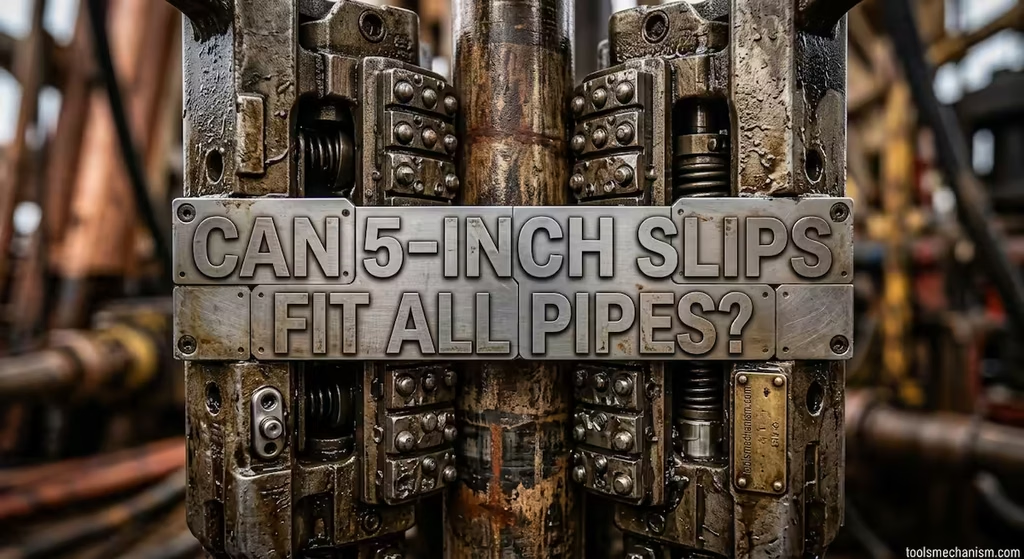
No, a 5-inch drill pipe slip cannot fit all pipes. Slips are precision-engineered to match the specific outside diameter (OD) of a drill pipe. A 5-inch slip is specifically designed for 5-inch OD pipes. Using it on smaller pipes will cause slippage, while using it on larger pipes will prevent proper seating in the rotary table, leading to severe equipment damage or rig accidents.
Table of Contents
What exactly is a Drill Pipe Slips?
A drill pipe slips is perhaps one of the most underrated yet critical safety tools found on any modern oil and gas rig. At its core, it is a multi-segmented, wedge-shaped mechanical device designed to support the immense weight of a drill string when it is disconnected from the elevators and suspended in the rotary table.
Constructed from high-grade alloy steel, these slips feature a tapered outer surface that matches the taper of the rotary table bowl. On the inside, they are equipped with replaceable hardened steel inserts, known as “dies” or “teeth.” When the slip is placed around the pipe and lowered into the bowl, the wedge action forces the dies to grip the pipe’s circumference. This creates a secure, friction-based hold that can support hundreds of thousands of pounds of steel pipe hanging miles deep into the earth’s crust.
Without a properly functioning slip, the entire drill string would simply plummet into the wellbore, resulting in millions of dollars in lost equipment and potentially life-threatening accidents on the rig floor.
The Engineering Behind the 5-Inch Drill Pipe Slips
The 5-inch drill pipe slips is engineered to meet specific API (American Petroleum Institute) standards, which ensure it can handle the extreme tensile and compressive loads encountered in deep-well drilling. The engineering starts with the metallurgy; these tools are forged from heat-treated steel to prevent brittle failure under high-torque conditions.
The geometry of a 5-inch slip is precise. The taper is usually designed at a ratio of 4 inches per foot, which provides the optimal balance between gripping force and the ease of removal. If the taper were too steep, the slip wouldn’t grip; if it were too shallow, it would become permanently stuck in the rotary bowl.
Furthermore, the 5-inch standard is widely used because 5-inch OD (Outer Diameter) pipes are the “workhorses” of the industry, balancing hydraulic efficiency with structural strength. Therefore, the 5-inch slip must be designed with enough “contact length”—the vertical area of the dies touching the pipe—to distribute the “hoop stress” evenly. This prevents the pipe from being crushed or deformed under its own massive weight.
Why Sizing Matters: The Mechanics of Friction and Grip
Understanding the mechanics of friction is essential to answering why a 5-inch slip isn’t universal. The gripping force of a slip is a direct result of the surface contact area and the coefficient of friction provided by the dies.
When you use a slip, you are essentially relying on uniform circumferential pressure. If the slip is perfectly matched to the pipe’s diameter (5 inches), the pressure is distributed 360 degrees around the pipe. This prevents “point loading,” where the pressure is concentrated in small spots.
If the sizes don’t match, the physics of the grip fail. A slip that is too large will only touch the pipe at its edges, leaving the center of the dies useless. A slip that is too small will pinch the pipe in the middle, creating a “crushing” effect. In 2026, with deeper wells requiring heavier pipe strings, the margin for error in sizing has shrunk to nearly zero.
Risks of Using an Undersized or Oversized Slip
The dangers of using mismatched slips cannot be overstated. Let’s look at the two primary scenarios:
- Oversized Slips (e.g., Using a 5.5″ slip on a 5″ pipe): In this case, the slip segments will not wrap around the pipe correctly. This results in “insufficient wrap,” leading to slippage. As the pipe slips, the dies can scar the metal, creating “stress risers” that eventually lead to pipe fatigue and failure underground. Even worse, the pipe could drop entirely.
- Undersized Slips (e.g., Using a 4.5″ slip on a 5″ pipe): Here, the slip creates an immense concentration of force in a small area. This often leads to “Egg-shaping” or crushing the drill pipe. Once a pipe is crushed or deformed, it can no longer pass through the blowout preventers (BOP) properly, creating a massive safety hazard. Additionally, an undersized slip will sit too high in the rotary bowl, preventing the “wedge effect” from locking properly.
Common Drill Pipe Sizes and Their Compatible Slips
To maintain rig safety, every tool pusher and driller must refer to a compatibility chart. While the 5-inch slip is common, it belongs to a family of sizes:
- 2 7/8″ Pipes: Require specialized small-bore slips, often used in workover operations.
- 3 1/2″ Pipes: Common in medium-depth wells; requires 3.5-inch slips.
- 4 1/2″ Pipes: A very popular size that requires its own dedicated 4.5-inch slip set.
- 5″ Pipes: Requires the 5-inch slip discussed in this guide.
- 5 1/2″ Pipes: Used in high-flow, high-pressure wells; needs 5.5-inch slips.
- 6 5/8″ Pipes: Found in massive offshore operations; requires heavy-duty large-bore slips.
Using the wrong slip from this list is an “unforced error” that professional drilling crews simply cannot afford. In 2026, many rigs are moving toward automated slip systems that use sensors to detect the pipe diameter before engaging, but manual verification remains the gold standard for safety.
The Historical Evolution of Drill Pipe Slips
The journey of drill pipe slips from simple manual wedges to the high-tech automated systems of 2026 is a fascinating story of engineering progress. In the early days of oil exploration, slips were basic heavy metal blocks that required immense physical strength to operate. Today, modern drill pipe slips are designed with ergonomics in mind, reducing the physical strain on the rig crew while increasing the gripping power by nearly 40%. This evolution has significantly decreased “lost time incidents” (LTI) on oil rigs worldwide, making the drill pipe slips a true lifesaver in deep-well drilling.
Material Science: Why Alloy Steel is the Standard
To understand why a drill pipe slips set is so heavy, we must look at the material science behind it. Most professional-grade drill pipe slips are forged from 4140 heat-treated alloy steel. This specific metal provides the perfect balance of tensile strength and hardness. In 2026, manufacturers are using advanced “cryogenic tempering” to make the teeth (dies) of the drill pipe slips even more durable. This ensures that the drill pipe slips can maintain their sharp grip even when dealing with the extreme temperatures and pressures found in 20,000-foot deep wells.
You may also be interested in How to get oil companies to drill on your land
Maintenance Tips for 5-Inch Drilling Slips
A 5-inch slip is a heavy-duty tool, but it is also a precision instrument that requires regular maintenance. Follow these steps to ensure your slips remain in “2026-ready” condition:
- Clean the Dies Daily: Use a wire brush and a cleaning solvent to remove dried mud (solid waste), oil, and debris from the teeth. Clogged dies lose their friction and become smooth, leading to slippage.
- Inspect for “Toothed” Wear: If the sharp edges of the dies become rounded or dull, they must be replaced immediately. Dies are the only thing standing between your pipe and the bottom of the ocean or the well.
- Lubricate the Backs: The outer tapered surface of the slip segments (the part that touches the rotary bowl) should be coated with a thin layer of high-pressure lubricant. This ensures the slip can be easily removed after it has held a heavy load.
- Check Hinge Pins and Bolts: Inspect the pins that hold the slip segments together. If they are bent or worn, the slip will not wrap around the pipe evenly.
- Non-Destructive Testing (NDT): At least twice a year, perform a magnetic particle inspection (MPI) to check for microscopic cracks in the steel body. A slip that breaks under load is a rig-floor disaster waiting to happen.
| Recommended Tool | Primary Use | Action |
|---|---|---|
| Ironclad Heavy Duty Work Gloves | Oil rig & pipe handling safety | Check Price |
| Digital Caliper (Measuring Tool) | Precise pipe OD measurement | Check Price |
Frequently Asked Questions (FAQ)
1. Can I use a 5-inch slip on a 4.5-inch pipe?
Absolutely not. Using a larger slip on a smaller pipe reduces the contact surface area, which leads to slippage and can drop the pipe string into the hole.
2. How often should I inspect my 5-inch slips?
In professional drilling operations, slips should be visually inspected after every trip and undergo a detailed non-destructive testing (NDT) every six months.
3. What is a “Multi-segment” slip?
Multi-segment slips are designed to wrap more evenly around the pipe, providing a better grip compared to older three-segment models.
4. Does the weight of the pipe affect slip selection?
Yes, heavier strings require slips with more “insert” or “tooth” surface area to handle the higher downward force.
5. Where can I find a 5-inch drill pipe slips chart?
Most manufacturers (like National Oilwell Varco or Cavins) provide specific size and load charts in their technical manuals.
Conclusion: Safety Always Starts with the Right Size
Choosing the correct drill pipe slips is not a matter of convenience; it is a matter of professional safety. While a 5-inch slip is a workhorse on many oil rigs, its limitations must be respected. Always verify the outer diameter of your drill pipe with a caliper before selecting your slip size. By following the guidelines in this 2026 update, you can ensure a safer, more efficient drilling operation.